
Prader-Willi Syndrome and Uncontrolled Obesity: Fatal triad of heart failure, respiratory failure and structural damage, case report.
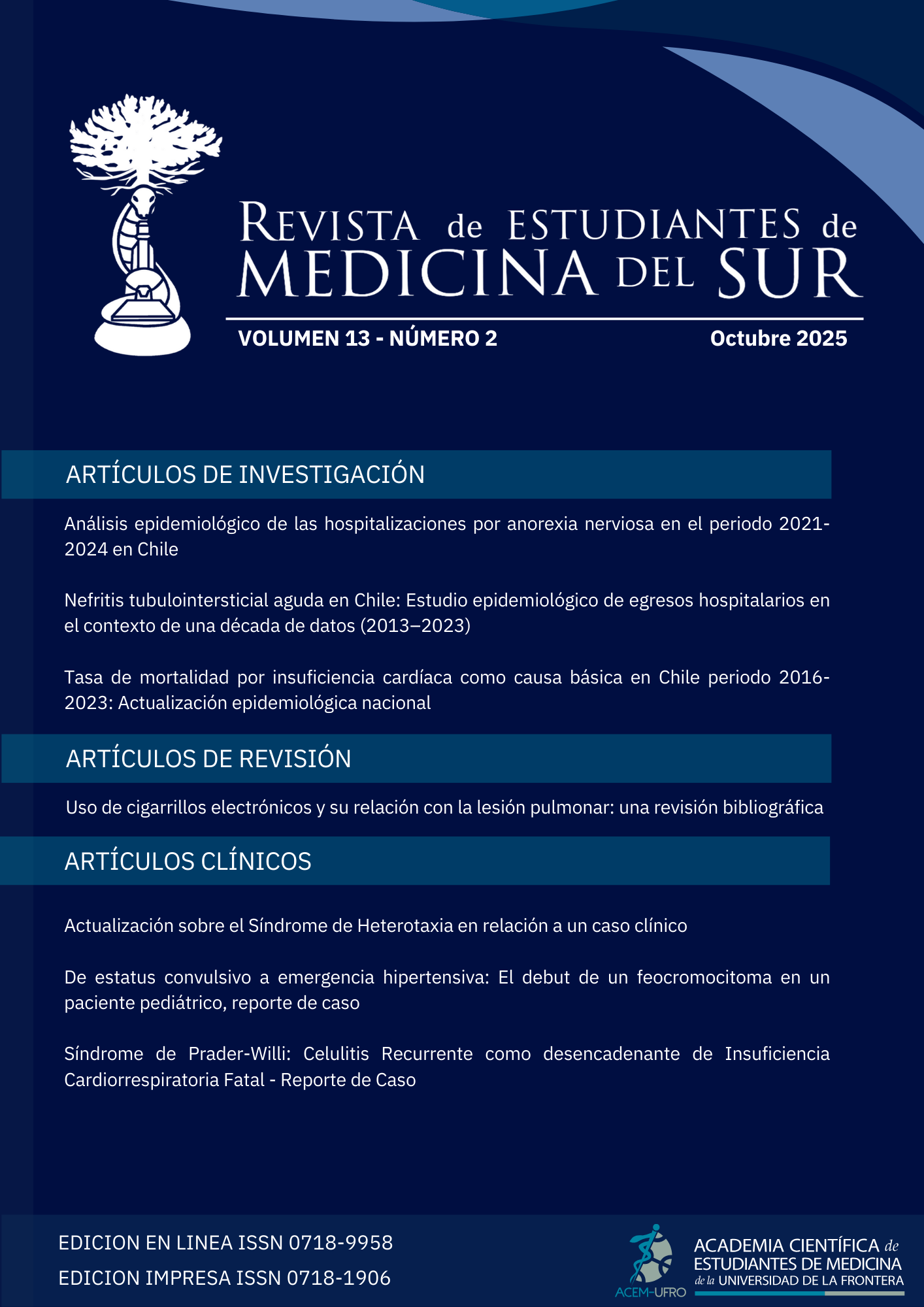
Prader-Willi Syndrome: Recurrent Cellulitis as a Trigger for Fatal Cardiorespiratory Failure - Case Report
DOI:
https://doi.org/10.56754/0718-9958.2025.254Keywords:
Prader-Willi syndrome, Obesity, Hyperphagia, Heart failure, Respiratory failure, HypercapniaAbstract
Prader-Willi syndrome (PWS) is a disease with high cardiopulmonary risk caused by morbid obesity, exacerbated by hyperphagia and low therapeutic adherence. A 25-year-old male patient with PWS, obesity (BMI 45.7 kg/m²), type 2 diabetes mellitus (HbA1c 10.3%) and congestive heart failure developed acute respiratory failure, cardiac decompensation (proBNP 2056 pg/mL) and congestive liver disease, evolving to refractory hypercapnia (pCO2 117 mmHg) and death despite noninvasive ventilation and intensive support. Persistent cellulitis and hypernatremia were triggers. The present case highlights the importance of early metabolic control that could prevent fatal outcomes in PWS. Echocardiography, which demonstrated type I diastolic dysfunction, as well as proBNP, are essential for the diagnosis and follow-up of heart failure with preserved ejection fraction. In addition, early detection of hypoventilation by polysomnography would be required for noninvasive ventilation to be effective and obtain better results. Hyperphagia, aggravated by neurocognitive impairment, requires multidisciplinary interventions (nutrition, behavioral therapy, supervised environments), mostly hampered by different social determinants. The interaction of metabolic and structural comorbidities would highlight the need for personalized and sustained interventions to improve prognosis in this high-risk group.
References
Duis J, van Wattum PJ, Scheimann A, Salehi P, Brokamp E, Fairbrother L, et al. A multidisciplinary approach to the clinical management of Prader-Willi syndrome. Mol Genet Genomic Med. 2019;7(3):e514. [consultado 2025 Jun 5]. Disponible en: https://doi.org/10.1002/mgg3.514
Butler MG, Manzardo AM, Heinemann J, Loker C, Loker J. Causes of death in Prader-Willi syndrome: Prader-Willi Syndrome Association (USA) 40-year mortality survey. Genet Med. 2017 Jun;19(6):635-642. [consultado 2025 May 17]. Disponible en: https://doi.org/10.1038/gim.2016.178
Asociación Nacional Síndrome Prader-Willi Chile. Síndrome de Prader-Willi. [consultado 2025 May 15]. Disponible en: https://www.prader-willi.cl
Sohn YB, Moon JE, Jung YJ, Yu YA. Updates on obesity in Prader-Willi syndrome: from genetics to management. Ewha Med J. 2023;46(s1):e33. [consultado 2025 May 13]. Disponible en: https://doi.org/10.12771/emj.2023.e33
Pellikaan K, van Weijen PMH, Rosenberg AGW, Hoekstra FME, Vermaak M, Oomen PHN, et al. What endocrinologists can do to prevent cardiovascular complications in adults with Prader-Willi syndrome: Lessons from a case series. Front Endocrinol (Lausanne). 2023;14:1145066. [consultado 2025 May 22]. Disponible en: https://doi.org/10.3389/fendo.2023.1145066
McDonagh TA, Metra M, Adamo M, Gardner RS, Baumbach A, Böhm M, et al. 2021 ESC Guidelines for the diagnosis and treatment of acute and chronic heart failure. Eur Heart J. 2021;42(36):3599-726. [consultado 2025 May 24]. Disponible en: https://doi.org/10.1093/eurheartj/ehab368
Angulo MA, Butler MG, Cataletto ME. Prader-Willi syndrome: a review of clinical, genetic, and endocrine findings. J Endocrinol Invest. 2015;38(12):1249-1263. [consultado 2025 May 23]. Disponible en: https://doi.org/10.1007/s40618-015-0312-9
Crinò A, Fintini D, Bocchini S, Grugni G. Obesity management in Prader-Willi syndrome: current perspectives. Diabetes Metab Syndr Obes. 2018;11:579-593. [consultado 2025 May 12]. Disponible en: https://doi.org/10.2147/DMSO.S141352
Bellicha A, Coupaye M, Mosbah H, Tauber M, Oppert JM, Poitou C. Physical activity in patients with Prader-Willi syndrome: A systematic review of observational and interventional studies. J Clin Med. 2021;10(11):2528. [consultado 2025 May 20]. Disponible en: https://doi.org/10.3390/jcm10112528
Kobayashi S, Murakami N, Oto Y, Toide H, Kimura N, Hayashi A, et al. Subtle cardiovascular abnormalities in Prader-Willi syndrome might begin in young adulthood. Intern Med. 2021;60(21):3377-3384. [consultado 2025 May 18]. Disponible en: https://doi.org/10.2169/internalmedicine.7073-21
Mueller C, McDonald K, de Boer RA, Maisel A, Cleland JGF, Kozhuharov N, et al. Heart Failure Association of the European Society of Cardiology practical guidance on the use of natriuretic peptide concentrations. Eur J Heart Fail. 2019;21(6):715-731. [consultado 2025 Jun 5]. Disponible en: https://doi.org/10.1002/ejhf.1494
Gillett ES, Pérez IA. Disorders of sleep and ventilatory control in Prader-Willi syndrome. Diseases. 2016;4(3):23. [consultado 2025 May 16]. Disponible en: https://doi.org/10.3390/diseases4030023
Chen C, Ioan I, Thieux M. Hypoventilation in patients with Prader-Willi syndrome across the pediatric age. European Respiratory Journal. 2023;62(Suppl 67):PA1888. [consultado 2025 May 16]. Disponible en: https://doi.org/10.1183/13993003.congress-2023.PA1888
Downloads
Published
How to Cite
Issue
Section
Categories
License
Copyright (c) 2025 Javiera Carolina Medina Palma, Sebastián Andrés Lerzundi Diaz, Josefa Carolina Correa Castro, Francisco Ignacio Contreras Brandt

This work is licensed under a Creative Commons Attribution-NonCommercial-ShareAlike 4.0 International License.